
South Devon Learning Disability Team Educational Content - Oral Care & People with Learning Disabilities
Client: South Devon Learning Disability Team
Project type: In-person training and professional education
Audience: Multidisciplinary healthcare professionals
Role: Content Development & Training Delivery
Period: July 2026
Relevant services: Dental & Healthcare Professional Education • Patient Education & Public Health Information
Project overview
I was invited to develop and deliver an oral-health education session for the South Devon Learning Disability Team after an oral-health knowledge gap was identified within the wider multidisciplinary team.
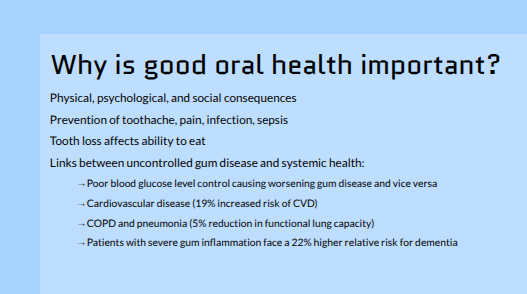
Discussions had highlighted misconceptions including the assumption that people without natural teeth no longer need dental care or cannot experience dental or oro-facial pain.
The resulting session was delivered in person to approximately 20–30 healthcare professionals from multiple disciplines.
The challenge
The audience included Learning Disability and Mental Health Nurses, Psychologists, Occupational Therapists, Allied Health Professionals and Doctors.
The challenge was not to teach non-dental professionals to diagnose dental disease. Instead, I needed to determine what dental knowledge would be relevant to their roles and translate it into information they could apply when supporting people with learning disabilities.
My role
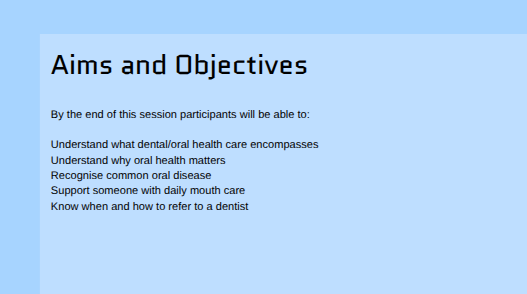
I independently developed the educational content and delivered the training. The learning objectives included helping participants to:
understand what dental and oral healthcare encompasses.
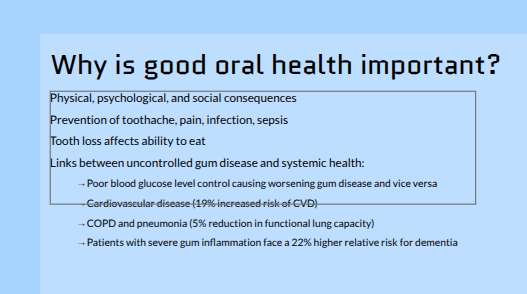
understand why oral health matters.
recognise common oral disease.
support someone with daily mouth care.
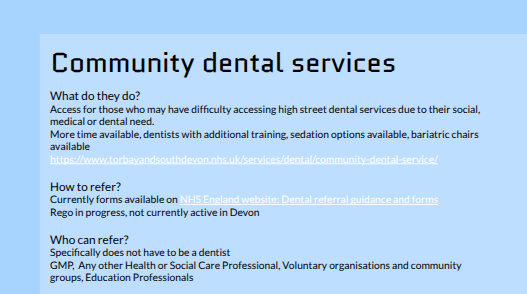
understand when and how to refer someone for dental care.
My approach
Audience-led educational design
Rather than providing a generic introduction to dentistry, I structured the session around challenges relevant to people with learning disabilities and the professionals supporting them.
Before the training, I created a Google Form through which participants could submit questions anonymously. The resulting content included:
common oral disease.
oral soft-tissue problems and potential oral-cancer warning signs.
dry mouth and medication-related oral effects.
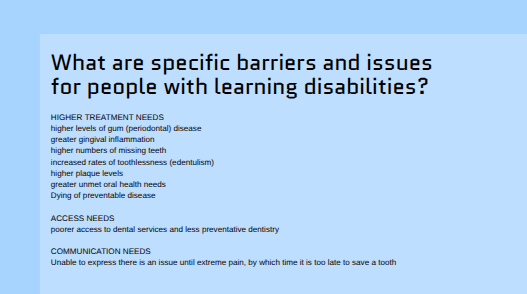
barriers to dental care.
communication and reasonable adjustments.
practical support with toothbrushing.
accessible resources.
dental services and referral pathways.
Practical and accessible education
The training translated clinical knowledge into practical actions. For example, the prevention section explored how carers and healthcare professionals could support toothbrushing using consistent routines, environmental adaptations, clear explanation and additional time while maintaining independence wherever possible. I also supplied different toothbrushes and toothpastes for participants to handle and signposted accessible resources including Makaton, prompt cards and Easy Read/video information.
Live clinical discussion
The in-person format allowed participants to relate the material to real situations encountered in practice. Questions included whether dental sedation could be provided in a patient's home. Drawing on my previous experience in domiciliary dentistry, I was able to discuss the distinction between treatment that can be delivered domiciliary and services requiring more specialist settings, alongside appropriate referral pathways. This allowed the session to extend beyond prepared material into clinically informed multidisciplinary discussion and practical signposting.
Deliverables
Oral Care & People with Learning Disabilities - HCP Educational Slide Deck
Website note: I'd strongly favour showing several selected slides or a visual preview rather than making the entire presentation downloadable by default.
Outcome
The session was well received and generated active discussion.
It addressed an identified oral-health knowledge need while providing practical information participants could use when supporting people with learning disabilities, particularly around prevention, daily mouth care, recognising potential problems and accessing appropriate dental services.
Skills demonstrated
Healthcare Professional education
Dental training for non-dental professionals
Educational content development
Multidisciplinary communication
Audience adaptation
Learning-objective development
Accessible health communication
Live training & clinical Q&A
