
Project type: Patient education, evidence review, clinical editing
Audience: Adult military personnel
Format: Single page A4 patient information sheet
Period: Original resource written in 2015; reviewed and updated in 2026
Relevant services: Patient Education & Public Health Information
Project overview
During my Dental Foundation year in 2014/2015, I was tasked to develop a single page patient information sheet. The theme was practical advice on preventing tooth decay. It was designed for adult military personnel attending dental appointments, particularly those identified as having dental caries. In 2026 I revisited this original resource to update it, assessing how the evidence, recommendations, and my approach to patient communication had developed.
The challenge
To update the clinical content using contemporary evidence. Improve the clarity, structure, and accessibility of the information. Retain the original single page A4 format. The resource needed to be practical, easy to scan, and suitable for use alongside personalised advice from the dental team.
My role
I researched and wrote the original information sheet in 2014/2015. I then reviewed the evidence base and updated the information sheet for 2026.
My approach
Evidence review and clinical editing
I undertook a targeted literature analysis relevant to oral health guidance for a UK population. The resulting documents included Delivering Better Oral Health: An Evidence-Based Toolkit for Prevention and relevant systematic reviews, including Cochrane evidence on fluoride toothpaste. I assessed whether the recommendations remained appropriate, whether claims were proportionate to the supporting evidence, and whether the information was relevant to the intended audience. This included reviewing recommendations on fluoride, dietary sugars, interdental cleaning and sugar-free chewing gum.
Content structure and health literacy
I reorganised the information around five clear preventive actions, followed by short explanations and practical advice. Supporting sections explain the causes of tooth decay and provide practical advice on cleaning, fluoride and dietary sugars. I used direct, actionable language, short sections and bullet points to make the information easier to navigate.
I retained appropriate clinical terminology, with clear explanations, to explain why everyday behaviours influence the development of tooth decay. It represents the level of discussion I have in a clinical setting, for example the use of the words demineralisation and remineralisation.
Format and design
I retained the original single page A4 format. I updated the formatting, using a restrained visual design with clear headings, bullet points, and typography representing the Gemma Wheeler Health Communications branding. The priority was accessible written information rather than decorative design.
Key improvements
Original Resource (2015)
Preventive advice organised under broad headings
Advice based on the 2014 prevention toolkit
Some categorical claims, including about sugar-free gum
Informal phrases such as “sugar attacks”
General advice on diet and oral hygiene
Basic A4 text layout
Updated Resource (2026)
Five key actions presented at the beginning
Updated using contemporary UK guidance and systematic reviews
Claims reviewed for relevance and strength of evidence
More consistent, direct and professional language
Practical instructions supported by explanations of tooth decay and prevention
Branded, structured A4 information sheet with clearer visual hierarchy
Deliverables
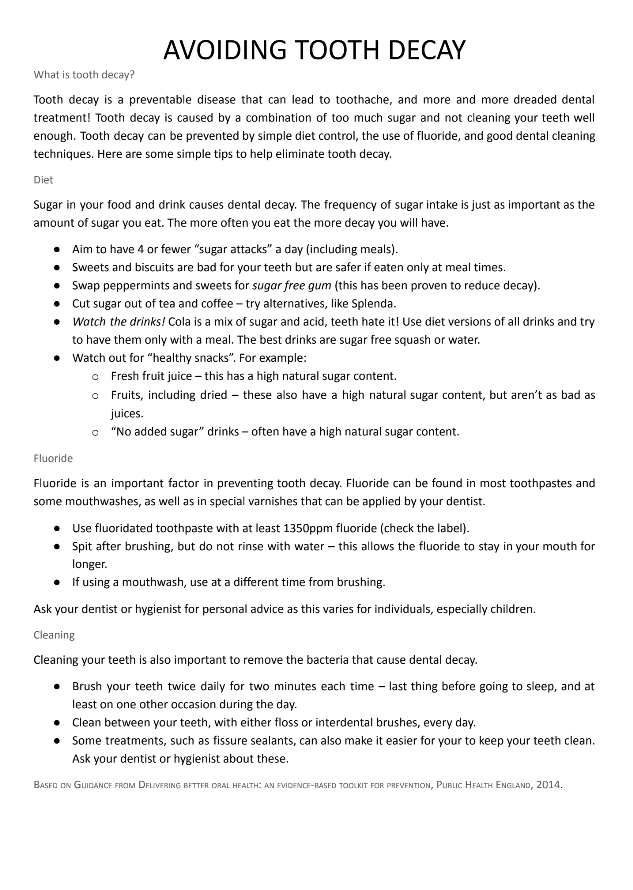
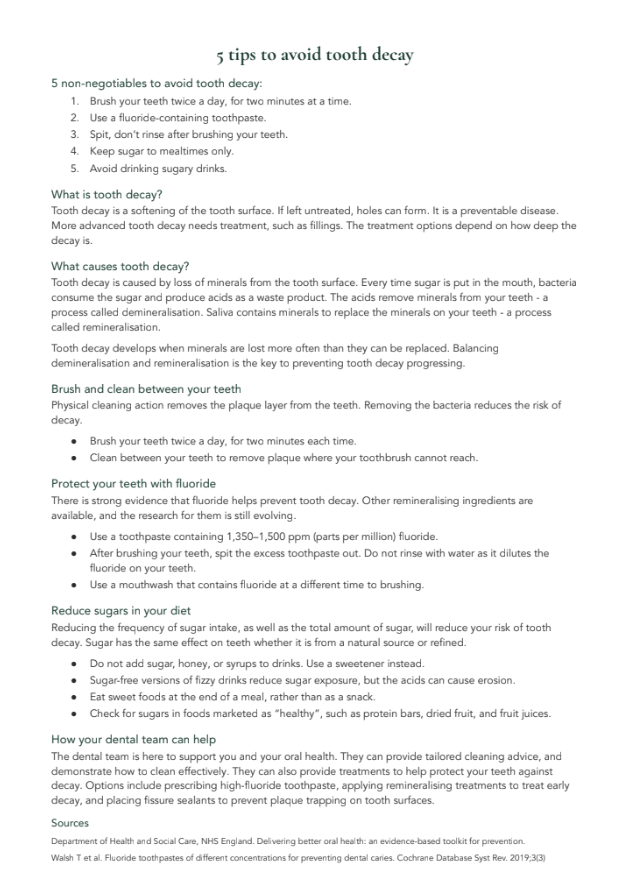
Outcome
The completed resource is an evidence based, single page patient information sheet for adult military personnel. It demonstrates the ability to:
Critically review existing patient information against clinical guidance and research evidence.
Evaluate the relevance and strength of clinical claims.
Translate evidence into clear, practical advice for a defined audience.
Make considered decisions about content inclusion, exclusion and emphasis.
Improve information structure and readability within a fixed format.
Editorial decisions and reflection
An important part of this project was deciding what information deserved space on a single page.
I deliberately prioritised recommendations supported by evidence for reducing tooth decay, rather than including every intervention that might benefit oral health. For example, although interdental cleaning remains part of the practical advice, I did not include it among the five headline recommendations because the evidence for plaque removal and periodontal health is stronger than the direct evidence for caries prevention. I intentionally did not comment on interdental brushes versus flossing, which would distract from the caries prevention messaging.
I also removed the original recommendation about sugar-free chewing gum. Although systematic review evidence supports a preventive benefit, I felt that explaining the evidence and the limitations would distract from the resource's core messages.
Other decisions reflected my clinical experience of communicating preventive advice. I retained a direct statement about natural and refined sugars because patients in practice often perceive honey, brown sugar, and other naturally derived sweeteners as less harmful to their teeth. I also retained the explanation of demineralisation and remineralisation to help readers understand why small, repeated behaviours matter.
I chose to communicate the established evidence supporting fluoride clearly, while acknowledging that research into alternative remineralising ingredients continues to evolve. As a clinician I understand that some patients are sceptical of fluoride use, and a communication style that is evidence based and investigative rather than prescriptive opens a conversation rather than alienating a patient who chooses not to use fluoride.
The final challenge was balancing clinical detail, readability and space. Rather than expanding the resource into a multi-page leaflet, I condensed and prioritised the information to preserve its original practical purpose.
Skills demonstrated
Medical & Dental Writing
Evidence Research
Dental Subject Matter Expertise
Accessible Health Communication
Patient Information Leaflets
Fact Checking
